
Digital Twin Platform for Renewable Assets (Wind and Hydro)
The Challenge
Managing the lifecycle of renewable generation assets — wind farms and hydroelectric plants — faces the critical need to optimise performance and extend the useful life of infrastructure. The energy operator sought to overcome the limitations of traditional management models, where design, construction, and operational information is entirely disconnected.
The challenge was to validate and implement an advanced BIM (Building Information Modelling) methodology capable of integrating not only the static parameters of the infrastructure, but also the dynamic dimension of real-time operation. The objective was to create an exact digital replica of a wind farm and a hydroelectric plant to optimise investment costs, improve maintenance, and reduce carbon footprint across all phases of the project.
The Solution
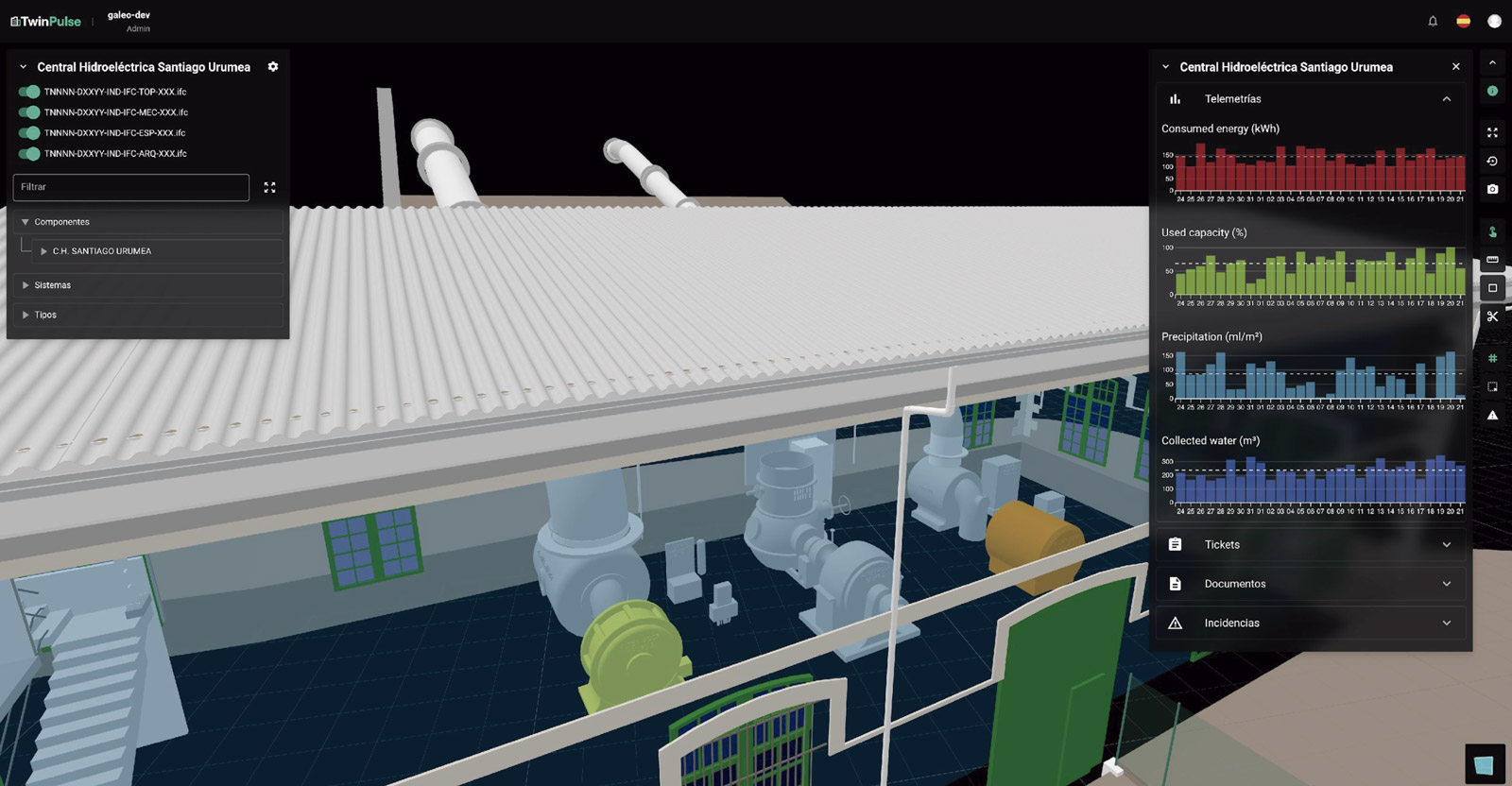
A pioneering pilot project has been developed based on TwinPulse, a Digital Twin generation platform applied to a wind farm and a hydroelectric plant. The solution is structured around several key components:
- Digital Twin Platform: A centralised environment capable of ingesting and processing large volumes of data to create virtual replicas of complex assets.
- OpenBIM-based Modelling: TwinPulse acts as a “digital skeleton”, automatically integrating standardised files (IFC and COBie).
- Wind and Hydro Twins: Structured, hierarchical representation of assets (Facility → Space → System → Component).
- Enriched Navigation: 3D visualisation connected to operational data via unique identifiers, enabling detailed asset analysis.
The platform also integrates advanced Big Data and AI capabilities on AWS:
- Virtual Sensors: Real-time calculation of complex indicators derived from multiple signals.
- Anomaly Detection: Use of Machine Learning to identify abnormal patterns without requiring prior historical datasets.
- Intelligent Alerting Engine: Statistical rule evaluation and logging for root-cause analysis.
- Scenario Simulation: “What-If” analysis combining simulated and real-world data.
Business Impact
The project has validated the use of immersive and analytical technologies for the management of critical assets.
- Performance Optimisation: Ability to adjust asset operation in real time based on precise simulations, maximising energy generation.
- Lifecycle Efficiency: Comprehensive management of information from design through to operation enables significant optimisation of both capital expenditure (CAPEX) and operational expenditure (OPEX).
- Carbon Footprint Reduction: Visualisation of environmental impact across all project phases allows active decarbonisation strategies to be embedded into the daily management of the plants.
- Methodological Validation: The success of the pilot lays the groundwork for the large-scale deployment of BIM methodology across future renewable developments.
Architecture & Technology
The solution stands out for the convergence of design, IoT, and advanced analytics technologies under TwinPulse’s cloud-native architecture.
- Core (BIM + IoT): Platform based on a unified Data Lake that correlates OpenBIM standards (IFC/COBie) with high-frequency telemetry.
- Analytics and Virtual Sensors: Creation of real-time derived metrics to evaluate the overall performance of multiple systems in an aggregated manner.
- Artificial Intelligence: Machine Learning models (Amazon SageMaker) integrated into the TwinPulse engine for unsupervised anomaly detection and predictive maintenance (Time-to-Failure).
- Scope: Spatial and hierarchical modelling of wind assets and complex hydraulic systems.
Customer Review
“Integrating IoT with BIM methodologies in our digital twins has given us absolute control over the lifecycle of our wind and hydroelectric plants. AI-powered simulations now enable us to take preventive action to optimise OPEX and radically reduce our carbon footprint.”